


For users in India, this point needs extra care. Rules around online money gaming, betting and gambling-related access have changed in recent years, and current reporting describes stricter controls around real-money play, user safety and age-related checks. Users should check the law that applies in their own state before using any gambling-related service.
| Basic rule | What it means in daily use |
| Adult users only | Do not access gambling-related activity if under legal age |
| Local law matters | Check rules in your own Indian state or region |
| Entertainment only | Do not treat gambling as income |
| Money risk is real | Any stake can be lost |
| Personal control | Stop when limits are reached |
| Support exists | Ask for help before the problem grows |
Gambling Is Not a Source of Income
Gambling is not a job, investment, savings plan or financial strategy. It should not be used to pay rent, cover bills, repay debt or recover money already lost. Any message that suggests a guaranteed profit, stable return or safe winning method should be treated as misleading.

A better starting point is blunt but useful: money used for gambling may be gone after the session. If that thought feels stressful, the stake is too high. If losing the amount would affect food, rent, transport, family needs, education, health care or loan payments, that money should not be used.
False ideas to avoid:
- A win must come after several losses
- A bigger stake can fix the previous result
- A bonus removes risk
- A favourite team is a safe bet
- A pattern can guarantee a result
- One more session will solve a money problem
Gambling becomes more dangerous when it is mixed with financial pressure. Entertainment can be stopped. A money problem usually keeps pulling the user back.
Know the Rules in Your State
India does not have one simple gambling rule that feels the same in every situation. Laws, restrictions and enforcement can depend on the state, the type of game, the platform, the money involved and current regulation. Reports on India’s updated online gaming framework describe stricter handling of online money games and a focus on financial flows and user safety.
Before using gambling-related content or services, users should check whether access is allowed in their own location. Do not rely only on search results, ads, app listings or claims from social media groups.
Check these points first:
- Your age and legal eligibility
- The law in your state or union territory
- Whether the activity involves real money
- Whether the platform is allowed to operate for your region
- Payment and withdrawal restrictions
- Tax or reporting obligations if relevant
- Responsible gambling tools offered by the service
This page is not legal advice. It is a safety guide. If the law is unclear, the user should seek qualified local guidance before taking any action.
Set Time and Spending Limits
Limits should be decided before the first bet, not after a loss. During play, the brain starts reacting to the last result, the next round or the current match. That is a poor moment to decide how much is enough.
Set three limits: money, time and frequency. The money limit should be an amount that can be lost without affecting normal life. The time limit protects sleep, work, study, family time and health. The frequency limit prevents gambling from becoming a daily habit.
| Limit type | Useful personal rule |
| Spending limit | Stop when the planned amount is used |
| Time limit | End the session after a fixed number of minutes |
| Stake limit | Do not raise the bet during the session |
| Deposit limit | No extra deposit after a loss |
| Frequency limit | Keep gambling away from daily routine |
| Break limit | Take a full pause after reaching the limit |
Useful limit rules:
- Decide the budget before opening the account
- Use only entertainment money
- Never use money for rent, loans, education or treatment
- Set a timer before starting
- Stop when the limit is reached
- Do not change the limit during play
- Keep payment apps away during emotional sessions
A limit is not a suggestion. It is the line where the session ends.
Avoid Emotional or Impulsive Play
Some states of mind make gambling more risky. Stress, anger, tiredness, anxiety, depression, alcohol, drugs or pressure from debt can reduce self-control. In that condition, the user may ignore limits, increase stakes or continue even after deciding to stop.
Playing after a loss is especially risky. The user may feel close to recovery and place another bet too quickly. That is usually emotion, not analysis.
Avoid gambling when:
- You are angry after a loss
- You feel tired or sleepy
- You are worried about money
- You have used alcohol or drugs
- You want to escape stress
- You feel pressure to win back money
- You cannot accept stopping immediately
A useful test is simple: would you make the same decision tomorrow morning with a clear head? If the answer is no, do not place the bet now.
Warning Signs of Problem Gambling
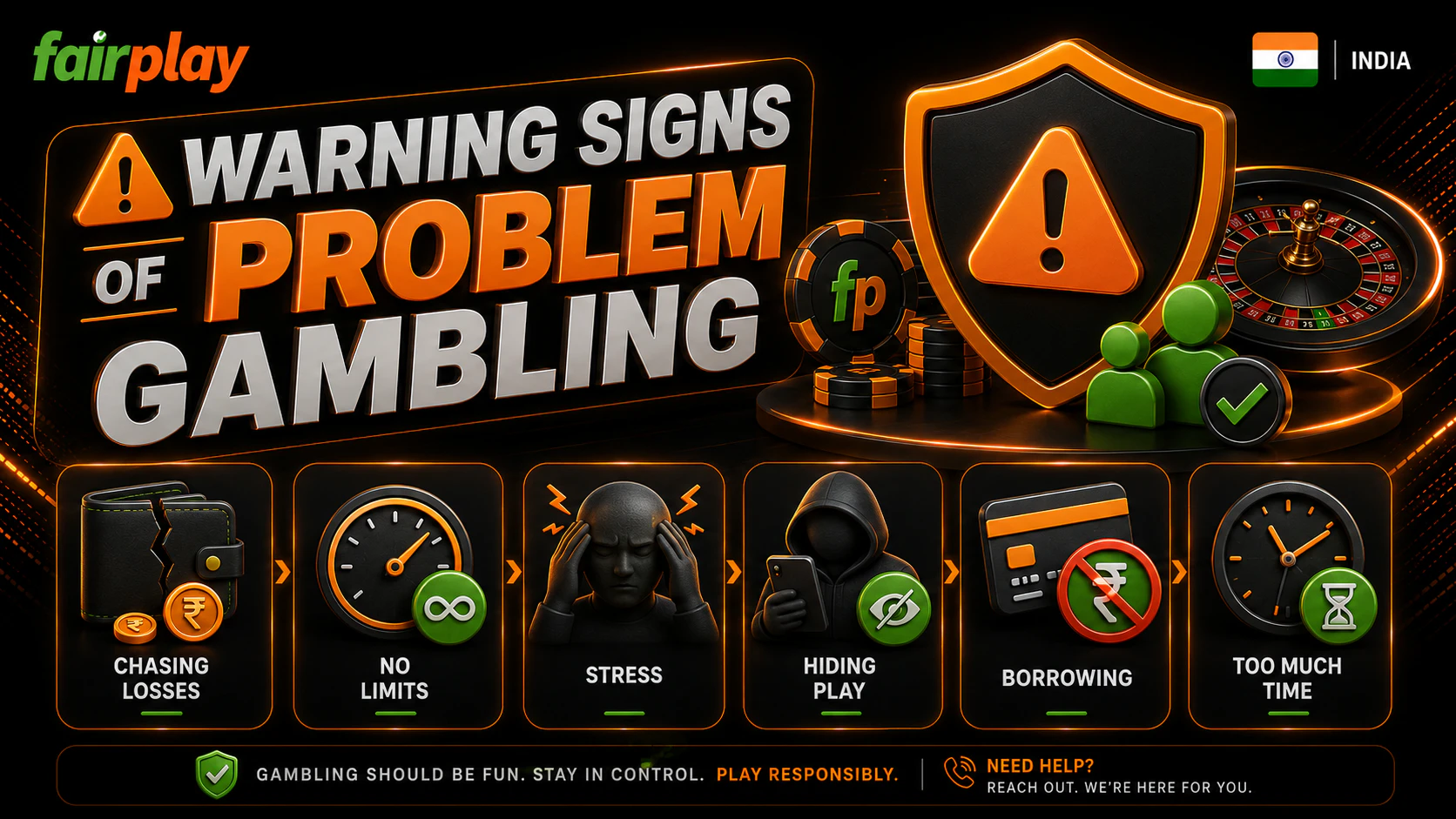
Problem gambling does not always start with a large loss. Sometimes it begins with small changes: more frequent sessions, hidden spending, late-night play or irritation when someone interrupts.
Watch behaviour, not only balance. A person can spend small amounts and still lose control over time, attention and mood.
Warning signs include:
- Trying to win back losses
- Increasing stakes after losing
- Borrowing money to continue
- Hiding play from family or friends
- Feeling irritated when asked to stop
- Playing longer than planned
- Losing sleep after gambling
- Missing work, study or family duties
- Thinking about gambling during normal tasks
- Feeling anxious after checking the balance
| Behaviour | What it may show |
| Chasing losses | Decisions are becoming emotional |
| Secret play | Shame or pressure may already exist |
| Borrowing money | Gambling is affecting real finances |
| Larger stakes | Risk is growing faster than planned |
| Poor sleep | Health and routine are being affected |
| Irritation when stopping | Control may be weakening |
If several signs appear together, the safest step is to pause before the situation becomes harder to manage.
Use Support and Self-Restriction Tools
Support should be used early, not only after a crisis. A user can start with practical tools: deposit limits, stake limits, session reminders, cooling-off periods, self-exclusion, app blockers and website blockers. Removing saved payment methods can also help slow down impulsive deposits.
Helpful steps include:
- Turn off gambling notifications
- Remove saved payment details
- Set account limits where available
- Use website or app blockers
- Take a full break after losing control
- Tell a trusted person what is happening
- Contact a counsellor or mental health professional
- Use self-exclusion if available
Users in India can also look for local mental health support. Reporting on the Tele-MANAS programme describes free, confidential helpline support through 14416 and 1800-891-4416, with 24/7 access and multilingual assistance.
Asking for help is not a failure. It is a way to protect money, health, work, study and family life. Gambling should stay small enough to stop. If stopping feels difficult, support is already worth using.